Cursed text shows up everywhere now social media bios, meme captions, Discord usernames. It looks chaotic, unstable, sometimes unreadable. And once you start experimenting with it, the question pops up almost immediately: can it go beyond decoration? If you’ve ever wondered Can cursed text be used for coding, you’re not alone. Many developers get curious after seeing distorted characters and ask whether that same effect could exist inside scripts, terminals, or software systems.
Some even compare it to visual distortions in Is cursed text the same as glitch? and try to understand if the effect is purely visual or technically functional.
At first glance, cursed text feels like it should break everything it touches. It stretches letters, stacks symbols, and makes ordinary words look corrupted. But under the surface, it’s just text. It’s built from Unicode characters — often combining marks layered on top of base letters. The deeper question isn’t whether it looks strange. It’s whether those strange characters behave safely inside programming environments.
Can cursed text be used for coding in real development environments?
This is where things get practical. When asking Can cursed text be used for coding, we have to separate theory from everyday development. Technically, cursed text is still valid Unicode. Programming languages like Python, JavaScript, and even C# can handle Unicode characters in strings. Modern systems use UTF-8 encoding by default, which supports thousands of character variations.
But support doesn’t equal suitability.
Most programming relies on clean source code formatting. Indentation, spacing, and predictable character structure matter. Cursed text introduces Unicode combining characters in programming contexts that aren’t visually obvious. A single visible letter might actually contain five or ten layered marks. That’s where confusion starts.
Code editors may display these characters differently. Some render them properly. Others misalign text, stretch lines vertically, or cause cursor positioning issues. Even when the compiler accepts the input, developers reading the file later might struggle to understand what they’re seeing.
So yes, cursed text can exist in code. That doesn’t mean it should.

How cursed text actually works under the hood
To understand the risk, it helps to understand the structure. Cursed text is usually made by stacking Unicode combining characters on top of a base character. These combining marks were designed for accents and diacritics in various languages. Zalgo text one of the most recognizable forms pushes this to an extreme.
Unlike glitch text created by corrupting data or image artifacts, cursed text is deliberate. It doesn’t break the file structure. It simply overwhelms the rendering engine. That’s why you might see discussions like Does cursed text work on other devices? because rendering varies by device and font support.
In programming environments, text encoding matters. If a file uses UTF-8 encoding consistently, cursed characters won’t automatically cause syntax errors. The interpreter reads them as data. The issue arises when those characters appear in identifiers, variable names, or comments that developers expect to be clean.
Unicode characters and programming compatibility
Modern development environments are Unicode-aware. UTF-8 encoding supports international alphabets, emojis, mathematical symbols, and combining characters. From a technical perspective, cursed text is valid data.
Yet compatibility depends on context:
- Strings inside programs usually accept cursed text safely.
- Comments often allow it without issue.
- Variable names may accept Unicode in some languages but not all.
- File systems may reject unusual characters in filenames.
This is where “can cursed text break source code” becomes a realistic concern. Not because the characters are malicious, but because invisible combining marks can interfere with readability. A variable name might look identical to another, yet contain hidden marks. That leads to confusion and debugging headaches.
Some compilers normalize text encoding internally. Others do not. The behavior isn’t consistent across languages.
Cursed text inside source code formatting
Source code formatting relies heavily on clarity. Even small invisible characters can change how code behaves. Zero-width spaces, for example, can break logic without being visible. Cursed text doesn’t usually include zero-width characters by default, but heavy combining marks can still distort visual alignment.
Imagine writing a function name that appears ordinary but contains layered combining marks. Another developer copies it manually, misses one mark, and the reference fails. The code technically runs, yet collaboration suffers.
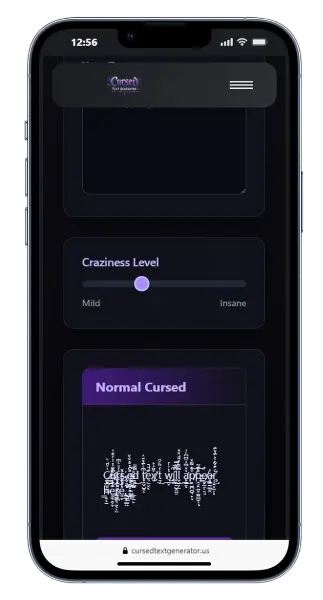
Code editors try to manage rendering. Some display combining marks clearly; others stack them in ways that push lines apart. Terminal displays can behave differently from graphical IDEs. That inconsistency alone makes cursed text risky in structured programming.
Could cursed text ever serve a technical purpose?
There are niche scenarios. Security researchers sometimes experiment with Unicode characters to test software resilience. Obfuscation techniques may involve unusual characters to confuse casual inspection. Tools like a cursed font generator demonstrate how flexible Unicode rendering can be.
Still, obfuscation using cursed text is rarely practical in production systems. Most code repositories emphasize maintainability. Teams rely on predictable naming conventions. Injecting distorted text for style or secrecy often causes more problems than it solves.
From a security perspective, though, Unicode manipulation is important. It helps developers understand spoofing attacks, homograph attacks, and encoding vulnerabilities. In that sense, cursed text becomes educational rather than functional.
Does Zalgo text cause coding errors?
Zalgo text is an exaggerated form of cursed text with heavy stacking above, below, and through letters. By itself, it doesn’t inherently cause syntax errors. Programming languages parse characters according to encoding rules, not visual appearance.
The problem appears when identifiers contain unexpected Unicode combining characters in programming contexts. If a language restricts identifiers to ASCII letters, Zalgo text will trigger errors. If it allows Unicode identifiers, it may compile successfully but become unreadable.
The phrase “does Zalgo text cause coding errors” depends on usage. Inside string literals? Usually safe. Inside structural keywords or syntax elements? Likely to fail. Inside comments? Technically fine, visually chaotic.
Different environments, different outcomes
Behavior varies across systems. A script saved in UTF-8 encoding and opened in a compatible editor might work perfectly. The same file opened in an older environment expecting ASCII may display corrupted characters.
Developers exploring various different styles of cursed text often don’t realize how dependent those styles are on font rendering engines. Some terminals collapse combining characters. Others exaggerate them.
Build pipelines can also react unpredictably. Continuous integration tools sometimes sanitize unusual characters. Linting tools might flag them as suspicious. Version control diffs can become messy because a single visible character may contain multiple code points.
Consistency matters more than creativity in collaborative development.
Are there limits to how much cursed text can be generated?
There isn’t a strict universal limit, though systems impose practical constraints. A generator can stack dozens of combining marks on one character, but rendering engines eventually struggle. Some platforms cap text length. Others clip excessive combining sequences.
Questions like is there any limit to generate cursed text come up because performance can degrade. Large sequences increase file size and processing overhead. In programming contexts, extreme stacking might slow down rendering in code editors or crash poorly optimised viewers.
That doesn’t make cursed text powerful in a technical sense. It just exposes the boundaries of Unicode handling.
Can cursed text break source code intentionally?
If the goal is sabotage, yes, unusual Unicode characters can introduce confusion. Homoglyph attacks replace letters with visually similar ones from other alphabets. Combining characters can disguise identifiers. These tactics exploit trust in visual similarity.
This connects back to text encoding. UTF-8 encoding allows wide character sets. Languages that permit Unicode in identifiers are particularly vulnerable to subtle lookalike replacements.
But this is not unique to cursed text. It’s a broader Unicode security concern. Most professional teams mitigate risks with linters, normalization rules, and repository policies that restrict unusual characters.


So when people ask whether cursed text can break source code, the honest answer is: it can complicate it, especially in careless environments. Deliberate misuse can create confusion, though modern tools increasingly detect anomalies.
Why cursed text is so weird
Part of the discomfort comes from perception. Our brains expect consistent letter shapes. Cursed text violates those expectations by stacking marks in unnatural ways. It feels corrupted, even though it isn’t.
There’s also a technical layer. Unicode combining characters were designed for linguistic accuracy. Zalgo text repurposes them aggressively. That mismatch between intended use and creative abuse produces the strange visual effect. Rendering engines were built to handle accents gracefully, not floods of overlapping marks. When dozens stack together, they strain layout algorithms. The result looks unstable, almost alive.
In coding contexts, that instability feels dangerous. Clean source code formatting reflects logic and order. Cursed text introduces visual chaos into a space built on structure. Even if it doesn’t break compilation, it unsettles readability.
So, can cursed text be used for coding? A grounded answer
After all this, the answer circles back to practicality. Yes, cursed text can technically exist inside code because it’s made of valid Unicode characters. Modern systems using UTF-8 encoding will store and process it correctly in many contexts. But asking Can cursed text be used for coding in a meaningful way leads to a different conclusion. It rarely improves functionality. It often harms readability. It may introduce subtle risks in collaborative environments.
In string data, it’s mostly harmless. In identifiers or structural elements, it becomes risky. In production systems, it’s generally avoided. Security research and experimental art projects might use it creatively, yet mainstream software development values clarity over visual distortion. So when someone wonders again, quietly, can cursed text be used for coding, the most honest answer is this: it can exist there, but that doesn’t mean it belongs there.