Zalgo Text Generator
Ẕ̷̜͔̈̓ą̴̘͖̽l̷̪̫̽̈́ġ̵͖̣̉o̶̖͚̊͝
corrupt your text with unicode chaos
Most text tools make things look cleaner. Neater. More polished. Zalgo text generator does the exact opposite and that’s the whole point. If you’ve ever seen text online that looks like it’s melting, glitching out, or being eaten alive by symbols, that’s Zalgo. Characters stacked on top of each other, letters drowning in marks that crawl above and below the line, the whole thing looking like something went seriously wrong. It shouldn’t be readable. Half the time it barely is. And people love it. So what actually is it, how does it work, and why does half the internet seem obsessed with it? Let’s get into it.
What Is Zalgo Text?
Zalgo text is regular text that’s been distorted using Unicode characters, tiny symbols that stack above and below normal letters until the text looks corrupted or broken. The name comes from an internet creepypasta character called Zalgo, a horror figure associated with chaos, madness, and corrupted images. The text style got named after it because the two things share the same energy. Distorted. Wrong. Like something normal that went bad.
When you use a Zalgo text generator, you type your regular words and the tool buries each letter under dozens of stacking marks. The output looks chaotic. Sometimes you can still read the original word underneath all the noise. Sometimes you really can’t. That’s adjustable most generators let you control how intense the effect gets.
Where Did This Even Come From
The Zalgo character itself started as a meme in the mid-2000s on internet forums. People started inserting Zalgo into normal image macros and memes distorting them, adding corrupted text, making regular content look like it had been infected by something.
The glitchy text style that came with it spread fast. It fit perfectly into a corner of internet culture that was already into horror aesthetics, ARG (alternate reality game) content, and creepy internet humor. The text looked broken in a way that felt intentional. Like a warning. Or like something had gone wrong with reality. From there it moved into memes, social media, horror-themed posts, and eventually just became a style that people use for the visual effect — separate from any connection to the original Zalgo character.
How Does It Actually Work
In Unicode, there’s a category of characters called combining diacritical marks. These are symbols designed to sit on top of or underneath other characters things like accent marks, dots, tildes. Normally they’re used sparingly. One mark per letter, maybe two. You know, like the accent in café or the tilde in Spanish words.
Zalgo text works by piling hundreds of these combining marks onto each letter at once. Your letter “a” gets stacked with mark after mark above and below it until it’s completely buried. Do that to every letter in a word and you get the full Zalgo effect text that looks like it’s collapsing under its own weight.
The original letters are still technically there. They’re just invisible under all the noise. That’s also why Zalgo text can be converted back to normal the original characters never actually disappeared, they just got covered.
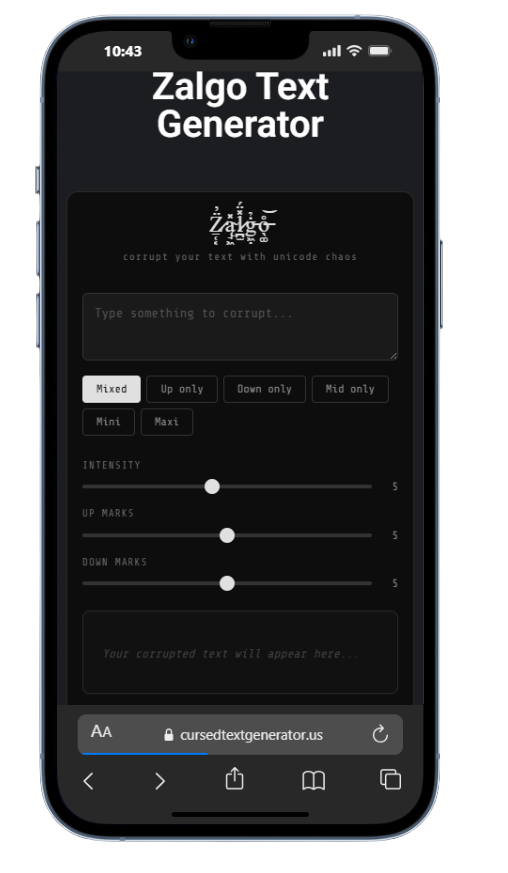
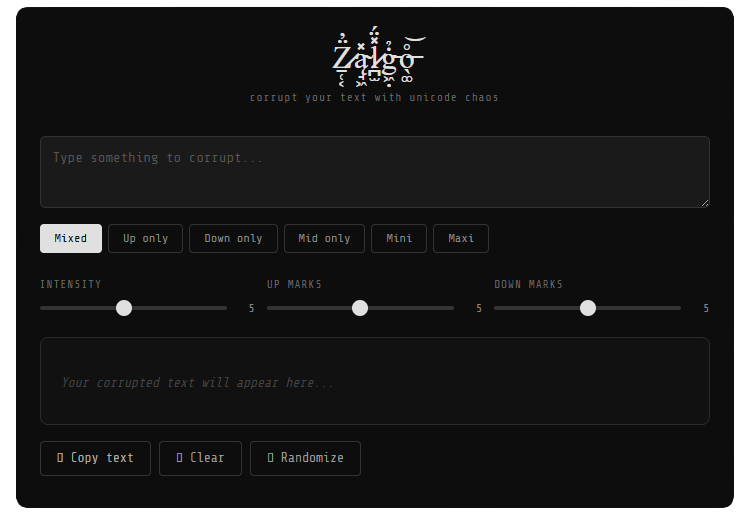
Most generators let you control three things: how many marks appear above the letters, how many appear below, and the overall intensity level. Some tools call it the “craziness level” which is pretty accurate. Low settings give you slightly distorted text. High settings give you something that looks completely unhinged. Well, you can also try cursed text generator which have almost 50+ font styles and other features too.
Why Does This Text Feel Wrong Even When I Can Read It?
This is probably the most common reaction people have the first time they see Zalgo text. The word is right there. You can make it out. And yet something about reading it feels genuinely uncomfortable like your brain is doing extra work it didn’t sign up for. That discomfort is real and it’s not random.
When you read normal text, your brain processes letter shapes almost automatically. You’ve done it thousands of times. The pattern recognition is so fast and familiar it feels effortless. Zalgo text breaks that pattern hard. The letters are still there but they’re buried under stacking marks that your brain has no automatic shortcut for. So instead of reading on autopilot, you’re suddenly working parsing through visual noise to find the actual characters underneath.
It’s the same reason a slightly-off face in a photo bothers you more than a completely wrong one. Your brain expects one thing, gets something close but distorted, and flags it as wrong. Zalgo text hits that same wire. Close enough to read. Wrong enough to feel unsettling. That gap between the two is exactly what makes it effective for horror content and exactly why it catches your eye when you’re scrolling past it.
Did Someone Break Their Keyboard, or Is This Supposed to Look Like That?
Fair question. The first time most people encounter Zalgo text they genuinely can’t tell if it’s intentional or some kind of technical glitch. It’s supposed to look like that. Every bit of it.
Zalgo text is generated deliberately using combining diacritical marks a specific category of Unicode characters that are designed to attach above or below other characters. Things like accent marks, dots, and tildes are the everyday version of these. Zalgo text just uses hundreds of them at once instead of one or two.
In Unicode, there’s technically no rule against stacking hundreds of combining marks on a single letter. The system allows it. Zalgo generators exploit that they pile mark after mark on every character until the text looks completely overloaded. Nothing is broken. Nothing malfunctioned. Someone just pushed a technical allowance as far as it goes and called it a style.
The keyboard is fine. The computer is fine. The person sending you Zalgo text just wanted it to look exactly like that.
Is My Brain Trying to Fix the Glitch While I Read It?
Yes. Genuinely, yes, and that’s a big part of why Zalgo text works as well as it does visually.
The brain doesn’t passively receive text. It actively fills in gaps, corrects distortions, and finds patterns even when the input is incomplete or noisy. It’s the same process that lets you read a sentence with mssing letters or make sense of blurry text on a bad printout. Your brain is doing cleanup work in real time without you asking it to.
With Zalgo text, that cleanup process kicks in hard. You’re visually sifting through the stacking marks, finding the base letters underneath, and reconstructing the word all while your brain is simultaneously processing the discomfort of the distortion itself.
The experience of reading Zalgo text is genuinely more effortful than reading normal text. Researchers call this cognitive disfluency when processing something takes more mental effort than expected. Studies have shown that information presented in a harder-to-read format actually gets more attention and gets remembered longer. The difficulty makes the brain treat it as more significant.
So yes, your brain is trying to fix what it’s seeing. And that effort is part of what makes Zalgo text feel more intense than regular text even when the actual words are simple.
Why Does Cursed Text Make Ordinary Messages Look More Dramatic?
Take a basic sentence. Something completely flat like “I’m fine.” Put it in Zalgo text and suddenly it reads like a warning from a corrupted signal or a message from somewhere it shouldn’t be coming from. The words didn’t change. The drama came entirely from the visual format.
This is the most underrated thing about Zalgo text and the reason it works so well in horror contexts even when the actual content is mundane. Visual presentation carries emotional weight independent of the words themselves. Broken, distorted, chaotic-looking text triggers a low-level threat response something looks wrong, something is off, the visual signal says danger even before you’ve parsed the actual message.
Horror writers figured this out early. A sentence like “she’s still in the house” in normal text is a plot point. The same sentence in heavy Zalgo text is genuinely unsettling. The content is identical. The visual presentation rewrites the emotional tone completely.
It’s also why Zalgo gets used in memes for ironic drama. Something completely ridiculous written in distorted glitch text reads as funnier because the format is so aggressively intense compared to the content. The contrast is the joke. Regular text can’t do that the same way.
What Impact Does Zalgo Text Create on Users?
Cursed text has a strong visual impact because it grabs attention before the brain even starts reading. Users tend to perceive it as mysterious, chaotic, unsettling, or funny depending heavily on context.
On social media, it increases engagement simply because people pause. You stop scrolling when something looks broken or wrong. That pause is half the battle for anyone trying to get their content noticed.
In gaming and meme communities, Zalgo text signals humor, irony, or digital chaos depending on how it’s used. In horror spaces it signals dread. Same visual tool, completely different register depending on where you drop it.
The trade-off is readability. Heavy Zalgo settings create a strong visual impact but make the text genuinely hard to read. Light settings keep it legible while still looking distorted. That balance between grabbing attention and actually communicating something is what experienced users figure out pretty fast.
Why Does This Look Like a Computer Error Instead of Normal Text?
Because it was designed to look exactly like that.
The visual language of computer errors glitched screens, corrupted file displays, scrambled characters has become its own aesthetic online. It carries a specific meaning even outside of actual technical failures. When something looks like a data error or a broken file, it signals chaos, wrongness, system failure. That visual shorthand is baked into internet culture after decades of people seeing what actual digital corruption looks like.
Zalgo text borrows that entire visual vocabulary on purpose. The stacking marks mimic what text looks like when a character encoding goes wrong, when a display driver glitches, when data gets corrupted mid-transfer. It’s not a real error but it looks like one, and that appearance carries all the associations that come with actual errors.
This is also why Zalgo text lands so well in science fiction and cyberpunk contexts, not just horror. A message that looks like corrupted data reads as futuristic, dystopian, system-breaking. The visual format implies something went wrong with the technology itself. Narrative shorthand delivered entirely through font choice or in this case, through intentional Unicode abuse.
Can You Reverse It
Yes. There are unZalgo tools online basically the opposite converter. You paste your Zalgo text in, it strips all the combining marks, and the clean original text comes back out.
This matters more than it sounds. If someone sends you Zalgo text in a message or you find it in a document and can’t read it, you don’t have to sit there squinting. Just paste it into an unZalgo converter and it’s readable again in a second.
Same goes if you create something in Zalgo for a post and later need the plain version back. You don’t have to retype it. Just reverse it.
What Do People Use Zalgo Text For
Mostly fun and creative stuff. This isn’t a professional formatting tool nobody’s putting Zalgo text in a work email or a business proposal. But in the right contexts it’s actually really effective.
Horror and creepy content
This is the big one. Zalgo text was basically made for horror aesthetics. Creepypasta stories, horror-themed social posts, Halloween content, scary game captions the distorted look adds something that plain text can’t. It feels off in a way that works perfectly for that genre.
Memes
A specific kind of meme uses Zalgo text as a punchline or atmosphere element. The “deep fried” meme aesthetic and heavily distorted content often include Zalgo-style text as part of the joke. If you’re in that corner of the internet, you already know what this looks like.
Social media standout posts
Some people use light Zalgo settings just to make their text look different. Not full chaos mode just slightly glitchy. Enough to catch someone’s eye while scrolling without being completely unreadable.
Gaming and online profiles
Usernames and display names in games or on forums sometimes use Zalgo text. It creates a look that’s hard to replicate and easy to spot. Some platforms allow it, some strip out the extra Unicode characters depends on the app.
Creative writing and digital art
Writers doing horror fiction online sometimes use Zalgo text to represent corrupted speech, a glitching AI, a demon character, or anything that’s supposed to feel wrong. Visual artists use it in graphics for the same reason.
Zalgo Text vs Weird Text — What’s the Difference
These two get confused a lot because they both make text look strange. Weird text uses Unicode lookalike characters symbols from other scripts that look similar to regular Latin letters but aren’t quite the same. The result is readable but slightly off. Like text written in a slightly wrong alphabet. It’s subtle.
Zalgo text doesn’t swap letters. It keeps the original letters and buries them under stacking marks. The result is much more extreme. Weird text looks unusual. Zalgo text looks broken. Both are used for similar things social media, memes, standing out online. But the visual effect is completely different. Weird text is strange. Zalgo text is chaos.
Things to Know Before You Use It
Platform support varies a lot.
Some apps handle Zalgo text fine and display all the stacking marks exactly as intended. Others strip the combining characters entirely and show just the plain letters underneath. Some show it correctly in the input field but strip it when you post. Test it on the actual platform before you go live with anything.
It’s basically unreadable at high settings.
That’s the point for a lot of uses. But if you actually need people to read what it says, keep the intensity low. Light Zalgo gives you the visual effect while still being legible. Full intensity Zalgo is more of a visual element than readable text.
Screen readers don’t handle it well.
Assistive technology that reads text aloud will try to read each combining mark individually, which produces complete gibberish. If there’s any chance your content will be read by someone using a screen reader, Zalgo text is not the right choice for that content.
It can be reversed.
Already said this but worth repeating , if you create Zalgo text and later need the clean version, unZalgo tools exist and they work well. You’re not stuck with the distorted version permanently.
Other Generators You’ll Find on the Same Sites
Zalgo generators usually sit alongside a bunch of other text tools cursive generators, bold text, fancy text with multiple font styles, small text, wide text, calligraphy, and more.
If you’re already on a site using the Zalgo tool, it’s worth browsing around. Most of these sites have ten or fifteen different converters on the same page. You might find something useful you didn’t know existed.
The fancy text generator especially that one shows you a huge list of different styles from a single input. Good for when you know you want something different but aren’t sure exactly what yet.
Zalgo text is one of those things where the concept sounds ridiculous until you actually see it in action. Stacked Unicode marks turning normal words into something that looks genuinely disturbing it shouldn’t work as well as it does.
But for horror content, memes, and anything that’s supposed to look corrupted or broken, nothing else quite does the same job. Type something normal, crank the craziness level up, and suddenly your text looks like it came from somewhere it probably shouldn’t have. Which is exactly why people keep coming back to it.
