If you’ve ever pasted normal words into a tool and watched them turn into something that looks broken, haunted, or glitched, you probably paused for a second. The letters stack, stretch, and spill above and below the line. It feels like the screen is malfunctioning. People often start by asking Is cursed text the same as glitch? and then quickly move on to something deeper. How does a cursed text generator work in the first place?

At a glance, it seems like the tool is distorting fonts. That’s what most assume. But it’s not actually changing the font file. It’s manipulating characters at a deeper level inside Unicode itself. A cursed text generator works by adding special invisible marks to standard letters, creating layered distortion without altering the original alphabet.
How does a cursed text generator work at the technical level
To really answer the question how does a cursed text generator work, you have to step away from design and look at encoding. Modern text is built on Unicode. Every letter, number, and symbol has a unique code point. These code points tell devices what to display.
A cursed text generator doesn’t invent new letters. It attaches extra Unicode combining characters to existing ones. These combining marks are meant for accents in languages like French or Vietnamese. Instead of placing a single accent mark above a letter, the generator stacks dozens of them.
The result looks like corrupted text, even though it’s technically valid Unicode.
Here’s a simplified example:
| Normal Character | Added Combining Marks | Visual Result |
|---|---|---|
| A | A + ◌̷ + ◌̿ + ◌͝ | A̷̿͝ |
| Z | Z + ◌͜ + ◌͎ + ◌̾ | Z͎̾͜ |
This stacking is the core mechanism behind glitch-style distortion.
When people ask how cursed text generator creates glitch effects, this is the answer. It layers Unicode combining characters above, below, and through letters until the text looks unstable.
Unicode and the Illusion of Corruption
Unicode combining characters were never designed to break text. They were designed to support language accents. The strange look comes from repetition.
Many users wonder, Does cursed text work on mobile devices? The short answer is yes, because mobile devices also support Unicode. Whether it’s a Zalgo text generator or another glitch text generator, the underlying encoding works the same way across platforms.
Still, rendering differs slightly. Some phones compress stacked marks. Others stretch them dramatically. That’s why cursed text may appear heavier on one device and lighter on another. The distortion isn’t random chaos. It’s structured stacking. That’s the key idea behind how Zalgo text works using Unicode.
Breaking Down the Algorithm Behind Cursed Text Generator
At its core, the algorithm behind cursed text generator tools is fairly straightforward. It follows these steps:
- Take user input (plain text).
- Loop through each character.
- Attach a random number of combining marks from predefined Unicode ranges.
- Output the modified string.
Here’s what that might look like conceptually:
| Step | Action |
|---|---|
| 1 | Input: “hello” |
| 2 | Select combining characters |
| 3 | Append marks to each letter |
| 4 | Output distorted text |
The generator often categorizes combining marks into three types:
- Above marks
- Below marks
- Through marks
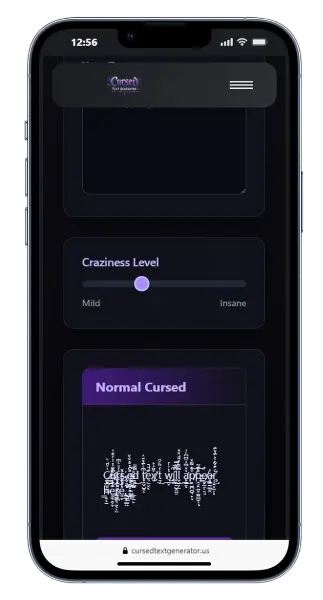
By adjusting how many marks are added, the tool controls intensity. Light distortion uses fewer marks. Extreme cursed text stacks dozens per character. That’s really how does a cursed text generator work repetition plus randomisation within Unicode boundaries.
Zalgo Text Generator and Its Unique Style
The Zalgo text generator is a specific type of cursed text generator that leans heavily into vertical distortion. It piles characters upward and downward in dramatic clusters.
When people ask how Zalgo text works using Unicode, the answer stays consistent: combining marks are stacked aggressively. The difference is in density.
Here’s a comparison:
| Tool Type | Mark Density | Visual Impact |
|---|---|---|
| Light glitch text generator | Low | Subtle distortion |
| Standard cursed text generator | Medium | Noticeable chaos |
| Zalgo text generator | High | Extreme vertical spread |
Zalgo text often extends far beyond normal line spacing. That’s why it looks almost infected, as if the characters are melting.
Is It Just a Font Trick? Not Exactly
Some assume a cursed font generator swaps your text into a special font file. That’s not accurate. A cursed generator doesn’t change the underlying font in most cases. It keeps your device’s default font but modifies the character composition.
Fonts decide how a single code point looks. Combining marks are separate code points layered on top.
That distinction matters. If cursed text relied on custom fonts, it wouldn’t copy and paste across platforms so easily. Instead, because it uses Unicode combining characters, the distorted text remains portable.

Why Text Distortion Looks So Dramatic
Text distortion happens when stacking exceeds what layout engines expect. Most design systems anticipate one accent mark per letter. When twenty marks are added, spacing calculations stretch vertically.
Rendering engines attempt to position each combining mark relative to the base letter. The more marks added, the more the engine struggles.
Here’s a simplified breakdown:
| Number of Combining Marks | Result |
|---|---|
| 1–2 | Accent-like |
| 3–5 | Slight glitch |
| 6–15 | Heavy distortion |
| 20+ | Extreme cursed appearance |
This stacking is the mechanical explanation for how cursed text generator creates glitch effects.
It’s not digital corruption. It’s overload.
Different Styles and Intensity Levels
Not all cursed text looks the same. Some generators allow users to control intensity levels. Others randomize output.
If you browse through different styles of cursed text, you’ll notice patterns:
- Minimal style: small upper marks only
- Vertical chaos: heavy top and bottom stacking
- Strike-through heavy: horizontal distortion
- Symbol overload: adds non-letter symbols between characters
Each variation uses the same foundation. Unicode combining characters but changes the distribution. The flexibility of Unicode is what allows so many glitch text generator variations to exist.
Is There a Technical Limit?
One question that comes up frequently is is there any limit to generate cursed text. Technically, there’s no strict Unicode rule limiting how many combining characters can attach to a letter. The limit is practical.
Browsers, apps, and social platforms may restrict character length. Rendering engines may slow down or truncate extreme stacking.
Here’s what can happen when limits are pushed:
| Situation | Outcome |
|---|---|
| Too many combining marks | Text overlaps excessively |
| Long cursed paragraphs | Performance slowdown |
| Social media copy-paste | Text trimmed or reformatted |
So while Unicode itself allows stacking, platforms impose real-world constraints.
Why Cursed Text Isn’t Actually Corrupted
Despite appearances, cursed text isn’t damaged data. It’s structured Unicode text. Every combining mark has a valid code point.
Corrupted text, by contrast, often involves encoding mismatches like UTF-8 interpreted as ISO-8859-1. That produces unreadable symbols. Cursed text generator output remains valid within Unicode standards. It just stretches design expectations.
This is why glitch text generator results can be copied into documents, bios, and comments without breaking encoding systems.
Security and System Behavior
From a technical standpoint, cursed text generator tools are low-risk. They don’t embed scripts in the text itself. Unicode combining characters are static code points. Still, extreme distortion can interfere with screen readers and accessibility tools. That’s something developers consider when integrating a text effects tool into public platforms.
Heavy stacking may also confuse automated moderation systems, since distorted words can bypass keyword filters. That behavior isn’t malicious by default, but it explains why some systems limit how much distorted text can appear.
The Role of Randomization
Randomization makes each output slightly different. Most cursed text generator algorithms use pseudo-random selection from predefined combining character arrays.
For example:
| Character | Possible Marks |
|---|---|
| Above | ◌̍ ◌̎ ◌̄ ◌̅ |
| Below | ◌̖ ◌̗ ◌̘ |
| Through | ◌̵ ◌̷ |
Each letter receives a random number of marks from these sets. That randomness creates the chaotic aesthetic associated with cursed text. Without randomization, the distortion would look patterned and predictable.
Platform Differences and Rendering Engines
Rendering engines like WebKit, Blink, and Gecko interpret combining characters slightly differently. That’s why Zalgo text generator output may look denser in one browser than another.
Mobile systems sometimes compress vertical spacing. Desktop browsers may allow taller stacking. The Unicode specification defines behaviour, but rendering details depend on implementation. That variability adds to the unpredictability people associate with glitch text.
Why Cursed Text Became Popular
Cursed text gained traction through meme culture. Its unsettling visual style fits horror themes and surreal humor.
The simplicity of the algorithm behind cursed text generator tools made them easy to implement online. No heavy design software required. Just Unicode manipulation. Over time, glitch text generator websites added intensity sliders and preview boxes, but the core logic stayed the same.
Comparing Unicode Text Generator Tools
Not every Unicode text generator produces cursed text. Some convert letters into fancy script or bubble characters by swapping code points entirely.
Here’s a comparison:
| Tool Type | Method | Result |
|---|---|---|
| Fancy font generator | Character substitution | Styled letters |
| Cursed text generator | Combining marks stacking | Distortion |
| Zalgo text generator | Heavy combining stacking | Extreme vertical glitch |
Understanding this difference helps clarify how does a cursed text generator work compared to other text tools.
The Simplicity Behind the Chaos
It’s funny, really. The output looks chaotic, almost broken. But the system generating it is straightforward.
Loop. Attach marks. Output string.
That’s it.
When someone asks how does a cursed text generator work, they often expect complicated encryption or visual rendering tricks. The reality is simpler controlled misuse of legitimate Unicode combining characters.
Final Thoughts on the Mechanism
So how does a cursed text generator work in plain terms? It takes ordinary text and layers Unicode combining characters onto each letter. The stacking overwhelms layout engines, producing visual distortion that looks corrupted but isn’t.
The glitch text generator and Zalgo text generator variations differ mostly in intensity. The algorithm behind cursed text generator tools remains consistent across platforms. It’s not broken code. It’s not hidden malware. It’s Unicode pushed past what it was visually designed to handle. And that’s what makes it interesting.